Vecqua
Competitive swimmingA race-strategy engine for swimmers. Converts seed times across pool formats, models fatigue lap by lap, and hands you a pacing plan you can read from the block.
So we measure both. Vecqor builds training instruments that log what you actually did, model it with proven formulas, and tell you exactly what to do next.
Every Vecqor app runs the same loop. The domain changes — the pool, the problem set — but the mathematics of getting better doesn't. Read the full method →
Capture real sessions with minimal friction — race splits, practice effort, problem attempts.
Score the data against your own baseline: variance, consistency, integrity of the record.
Published formulas project your next performance, tuned by your log.
The model condenses to one clear instruction, right before or after it matters.
Each Vecqor app is a purpose-built instrument for a single skill — starting in the water and on the page.
A race-strategy engine for swimmers. Converts seed times across pool formats, models fatigue lap by lap, and hands you a pacing plan you can read from the block.
A mastery engine for mathematics. Treats every solved problem as a data point — classifying errors, modeling retention, and scheduling exactly the practice that moves your score.
Vecqua converts your seed times across pool formats, models fatigue lap by lap, and condenses it all into one cue you can hold in your head behind the block — then checks the result against the plan when you touch the wall.
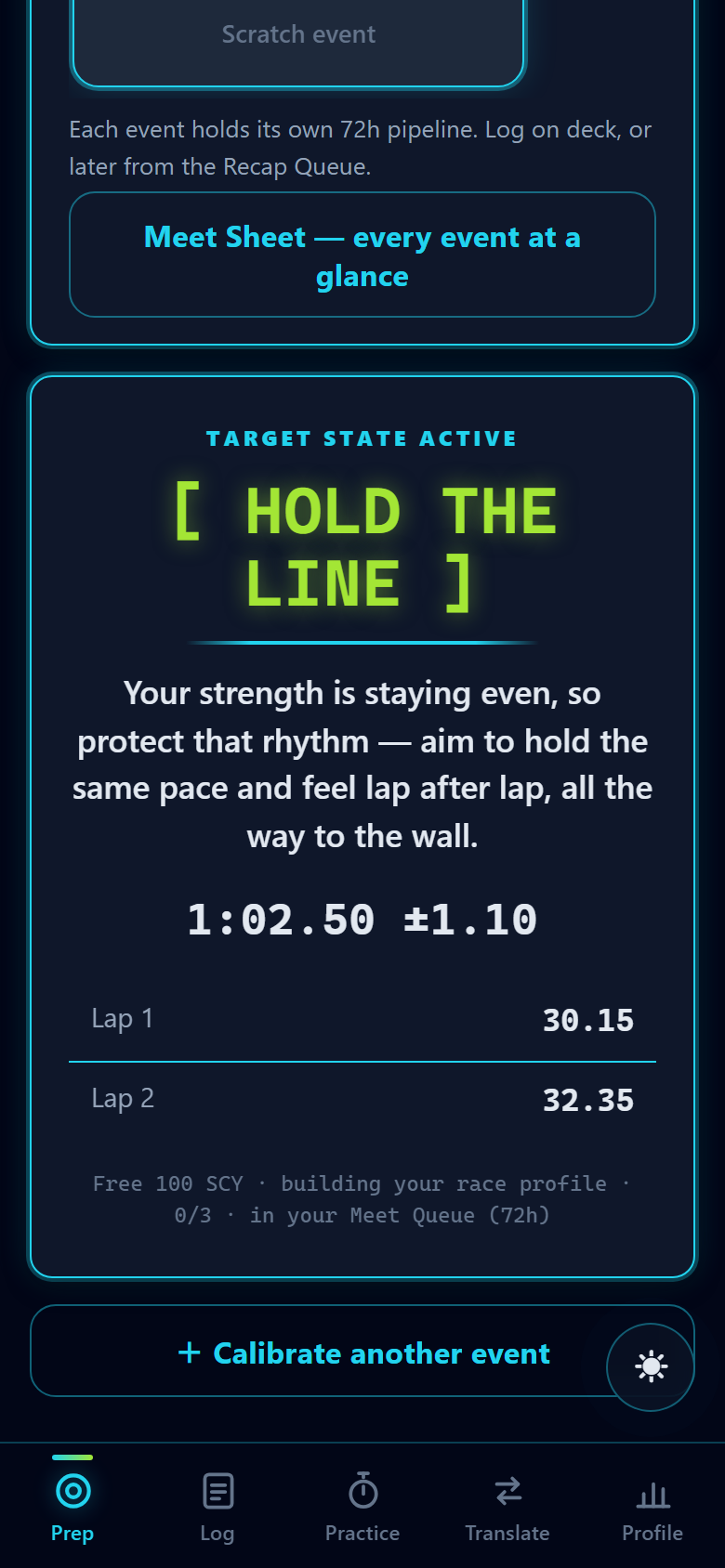
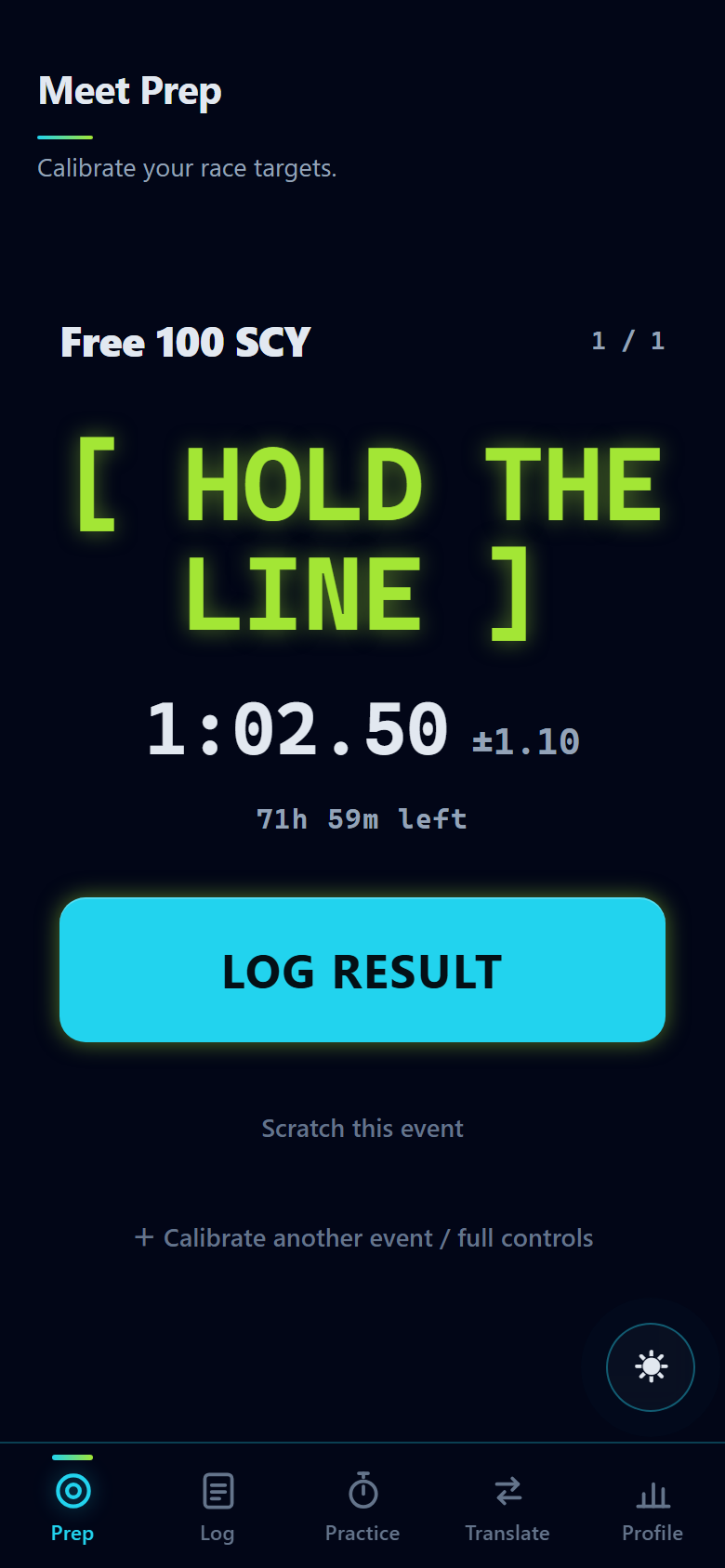
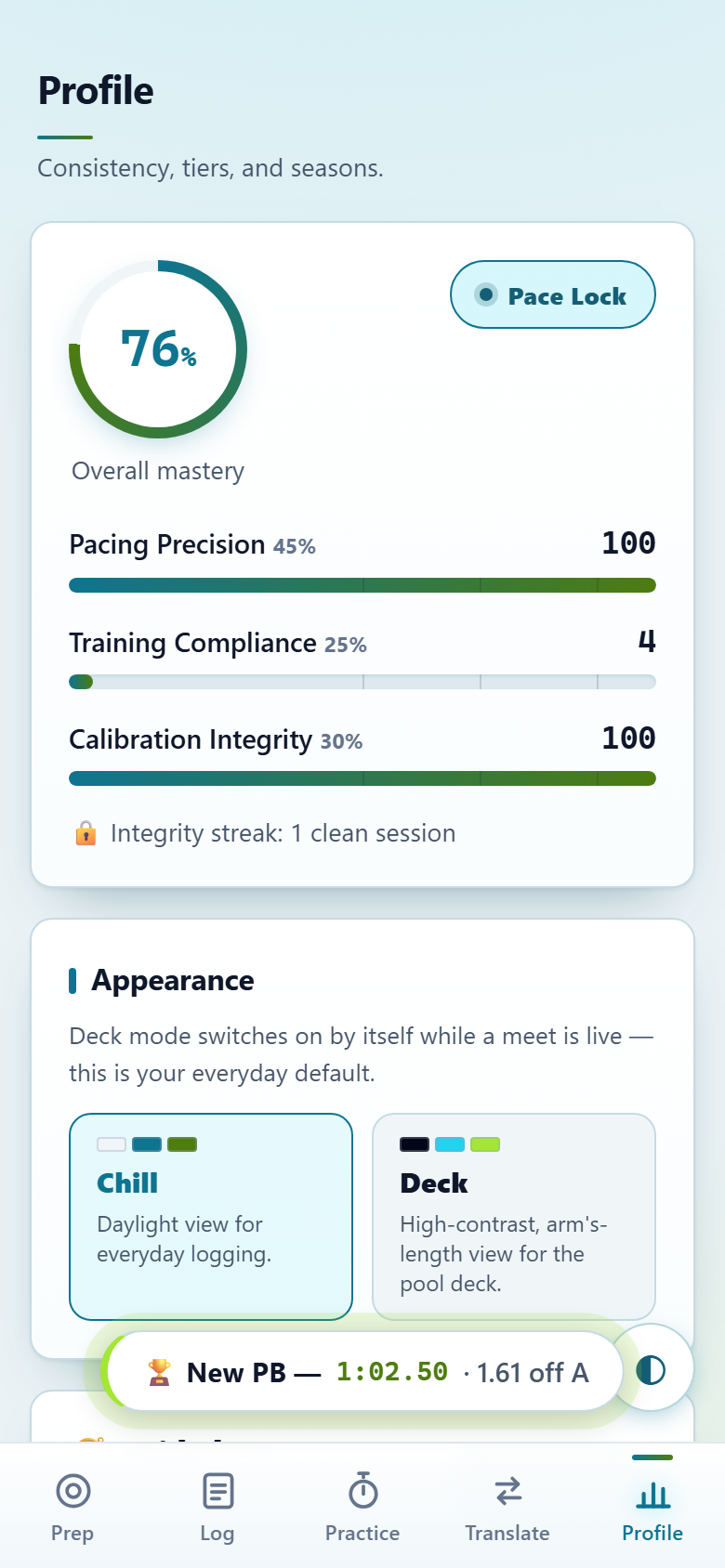
Everything runs on-device, thumb-reachable from the pool deck, in a chill-mode / deck-mode adaptive theme.
Run a pacing calibration before your heat. Warm-up hydrodynamic checks — gutters, floor slope, lane lines — feed drag penalties into the projection, then a cue token and one physical directive render deck-ready.
Log seed, final, and lap splits per event in a mono ledger. A DQ triage — mental lock, turn slip, gear failure — routes to coaching alerts instead of softening your targets.
One RPE slider, benchmarked 1–10. A +1.5s push-off penalty separates practice efforts from block-dive speeds, and an honesty check keeps the model calibrated.
Instant SCY ↔ SCM ↔ LCM conversion between heats. Type any one time, get the other two — no environmental modifiers, just clean physics.
The Consistency Index scores pacing precision, training compliance, and calibration integrity into a public tier — earned by discipline, not talent.
Split targets are what a swimmer trains to. Mid-race they're useless — nobody reads a clock at race pace. So the last thing Vecqua prints before the heat is a single cue, picked from how that swimmer has actually been racing:
One master equation projects your short-course seed into a long-course target, then chunks it into per-50 splits along a modeled fatigue curve.
Distance multiplier, turn-factor advantage, stroke hydrodynamic coefficient, age-fatigue cushion (with a prodigy override for outlier velocities), and summed environmental drag penalties.
The block-launch factor buys back time on the opening lap; the rest decays linearly (±0.4s) across laps 2–4 to model lactic accumulation.
| 200 FR · LCM | target | actual | Δ |
|---|---|---|---|
| 50m | 35.71 | 35.62 | -0.09 |
| 100m | 36.78 | 36.91 | +0.13 |
| 150m | 37.18 | 37.30 | +0.12 |
| 200m | 37.58 | 37.44 | -0.14 |
Vecquan treats every solved problem as a data point. It classifies your errors, models what you'll remember and when you'll forget it, and schedules exactly the practice that moves your score.
Retention decays predictably — so Vecquan schedules each review to land just before it drops below the threshold.
| concept | mastery | retention | next review |
|---|---|---|---|
| quadratics | 0.92 | 0.88 | in 6d |
| trig identities | 0.74 | 0.61 | tomorrow |
| limits | 0.58 | 0.49 | today |
Every miss is classified — because the fix for a concept gap is nothing like the fix for time pressure.
The underlying idea isn't there yet. Vecquan routes you back to foundation problems on that concept before re-testing it.
Right idea, wrong execution — a dropped sign, a skipped step. Prescription: short high-rep drills, not re-learning.
Correct when untimed, wrong on the clock. Prescription: timed sets at gradually tightening pace targets.
Advice in most training apps is editorial. In Vecqor apps it is the output of an equation you can inspect — every coefficient named, every score decomposable back to your own logged data.
The domain changes — the pool, the problem set — but the mathematics of getting better doesn't.
Capture real sessions with minimal friction — race splits, practice effort, problem attempts. No estimates, no vibes.
Score the data against your own baseline: variance from plan, consistency of effort, integrity of the record itself.
Published formulas project your next performance — distance conversion, fatigue decay, forgetting curves — tuned by your log.
The model condenses to one clear instruction, delivered right before or right after the moment it matters.
Every Vecqor app scores you the same way: how precisely you executed the plan, how consistently you trained, and how honestly you logged it.
The Consistency Index: a weighted score that rewards racing to plan, training regularly, and never cherry-picking your data. A 72-hour pipeline lock keeps every calibration accountable to an outcome.
Your score maps to a public tier — earned by discipline, not talent. The same scoring philosophy carries into every Vecqor app.
Vecqua and Vecquan are in active development at Vecqor. Join the waitlist and be first on the block when they launch.